
Navigation

All Countries

Solutions

Multi-Country Operations Enterprise & White-Label Field Workforce For Consultants & Payroll Bureaus

Industries

NGOs & INGOs Security Companies Hospitals & Healthcare Sales Teams Manufacturing See all industries โ†’ Platform & Modules Salary Calculators Pricing Blog
Geofence clock-in ยท site visits ยท route history ยท offline

GPS Employee Tracking
for Field Teams
Across Africa.

Know which site each technician, guard or sales rep is at, when the work started and when it ended. Staff clock in from their phone, with or without signal, and the approved time goes to payroll.

Works offline Employee switches tracking on Feeds payroll
One field day
What the record shows
Example
  1. 07:58
    Clocked in
    Depot ยท inside geofence
  2. 09:10
    Site visit started
    Client site ยท GPS + photo
  3. 11:35
    Site visit ended
    Duration worked out automatically
  4. 13:20
    Clocked in again
    Other site ยท waiting for approval
  5. 17:05
    Clocked out
    Saved offline ยท synced later
Sound familiar?

Where is your field team right now, and when did the job start?

When technicians, guards and sales reps are spread over many sites and counties, head office is usually the last to know.

Nobody can say when work on site began or ended

The job card says a full day. The client says the team arrived at noon. Without a time and a place on record, you cannot settle it either way.

Ghost workers and buddy punching

A name is signed in the register at a site the person never reached, or a colleague signs for them. You pay for hours nobody worked.

Patchy mobile signal

Sites outside town drop off the network for hours. An attendance app that needs a live connection goes unused, and the paper register comes back.

Paper timesheets and month-end disputes

Timesheets reach the office after payroll cut-off. Overtime and field allowances are argued from memory, and corrections spill into the next month.

Geofence clock-in

How does geofence clock-in work?

Each site gets a GPS position and a radius. Every punch is matched against your sites, and you decide what happens to the ones that do not fit.

GPS clock-in and clock-out

From the mobile app or the web

The position is saved with every punch and shown on the attendance record with the site name. In the mobile app a photo can be taken at the punch.

A geofence for every site

Position plus radius in metres

Set the position and radius on the branch itself, or add separate geofence zones for depots, client premises and project sites.

What if the punch is outside the fence?

Your rule: flag it or hold it

The punch is recorded and marked outside the geofence. Choose whether it is only flagged, or waits for a supervisor or HR to approve it.

What if they clock in at another site?

Always marked "Other site"

A clock-in at a company site that is not the employee's own branch is marked on the record. By default it also needs approval; you can relax that.

Field clock-ins go to the supervisor

Approved from the phone

A clock-in marked as field work notifies the direct supervisor, or HR when there is none. Supervisors approve or reject in the mobile app.

When GPS or the phone fails

Manual entry by HR

HR can enter attendance by hand for someone whose phone was dead or lost, so the day is not missing from the record.

Office staff, biometric devices and web check-in are covered on the Attendance & Leave page.

Site visits

How do you track site start and end time?

Clock-in tells you the person started the day. A field activity tells you what happened at each stop. The employee starts a timed activity when the job begins and ends it when the job is done.

  • Start and end each carry a time, a GPS position and an address.
  • A photo can be attached at the start and at the end.
  • The duration is worked out on the server, not typed in by the employee.
  • You define the activity types: installation, patrol, delivery, client visit, or your own.
  • Quick notes without a timer are logged the same way, with GPS and a photo.

What can managers do with the visits?

See them in a list and on a map. Filter by employee and by day, week or month.

Hand a client or auditor proof of the visit. The visit verification pack is a PDF of the GPS position, address, time and start and end photos for each visit by one employee over a date range.

See which places were covered. The coverage report lists the locations visited in a period and how many times.

The verification pack and coverage report depend on your plan. Ask us in a demo.

Map and route history

What do the field staff map and employee route history show?

While an employee has field tracking switched on, their phone records a position every few minutes or when they have moved. Managers open one map to see the team.
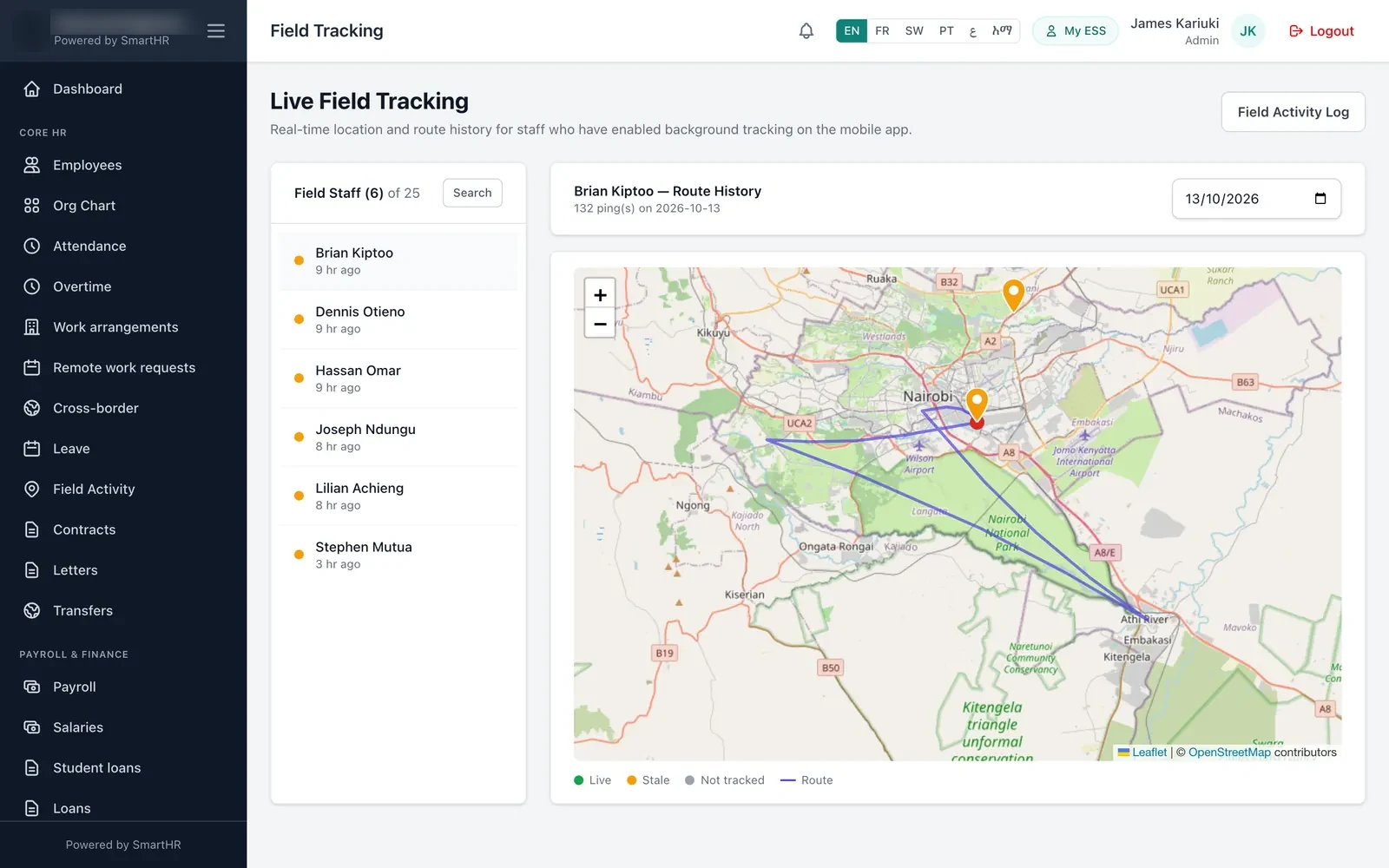
SmartHR Africa field tracking screen: field staff list and a map showing one technician's route for the day around Nairobi
Field tracking: pick an employee to see the day's route and last known position. Demo data.

Last known position

Each tracked employee appears on the map at their most recent position, with a status showing whether that position is recent or old, and when they were last seen.

Route for any day

Pick an employee and a date to draw that day's route on the map, with the first and last points marked. Days are read in the employee's own time zone.

Positions survive lost signal

Positions are stored on the phone first and uploaded in the background, so a stretch without network fills in once the phone reconnects.

Privacy

Is employee GPS tracking fair to staff?

It can be, if people know what is collected and are in control of it. SmartHR is built on that basis.

The employee switches tracking on

Field tracking is a switch in the mobile app. The employee turns it on for field work and off again when they are done.

A clear disclosure comes first

Before the phone asks for location permission, the app explains what is collected, that it continues while the app is closed, and why.

A notification while it is on

While tracking is running, the phone shows a permanent notification saying that location is being shared.

Only the right people can look

Supervisors see their direct reports only. Country HR sees its own country. A clock-in on its own records one position, not a trail.

Data protection law differs by country. Tell your staff about tracking in your own policy and take local advice on what your employment contracts should say.

Offline

Does the GPS attendance app work without signal?

Yes. GPS does not need mobile data, so the phone still knows where it is. The mobile app saves clock-ins, clock-outs, field activities and tracking positions on the phone and sends them when the network returns.

  • No duplicates. Every queued item carries its own ID. If the phone sends it twice after a weak connection, the second copy is ignored.
  • The real time is kept. The punch keeps the time it happened, not the time it was uploaded, and punches are processed in the order they happened.
  • One bad item does not block the rest. Each item is accepted or refused on its own, with a reason.
  • A limit on very late uploads. A punch that arrives more than 30 days after it happened is refused and goes to HR for manual entry.

How does field time reach payroll?

The same record that shows where the work happened is the one payroll reads. Nobody retypes a timesheet.

Clock in
Employee
GPS position matched to a site; saved offline if there is no signal
Site visit
Employee
Timed activity with start, end, position and photos
Approve
Supervisor
Field punches, exceptions and overtime, from the phone
Payroll
HR and finance
Approved overtime and field allowances in the next run
Late minutes and hours worked against the shift
Overtime paid only after approval
Field allowance at your daily rates per country

See how the numbers are paid on the Payroll & Statutory Compliance page.

Which teams use GPS field tracking?

Any employer whose people start the day somewhere other than head office.

Technicians and engineers

Installation and maintenance crews moving between client sites. Start and end times for every job.

Field workforce โ†’

Security guards

A geofence at every post, and clock-ins at the wrong post flagged for the supervisor.

Security companies โ†’

Construction crews

One geofence per project site, and every clock-in recorded against the site it happened at.

Construction โ†’

Drivers and sales reps

Route history for the day and a logged stop at each customer.

Logistics โ†’

Managing field sales reps? See HR, payroll and GPS tracking for sales teams: customer visits, commission, field allowances and expenses in one payroll.

Running a guarding company? SecureForce adds rosters, QR patrols and client invoicing. Paying construction crews by the day? SiteForce lets foremen check whole crews in. Both are from Emeran Systems Ltd.

Questions buyers ask about GPS employee tracking

Don't see yours? Ask the team โ†’

Each person clocks in and out on the SmartHR mobile app or on the web. The GPS position is saved with the punch and compared with your sites, so the record shows the site name or "outside geofence". In the mobile app a photo can be taken at the punch. Clock-ins marked as field work go to the supervisor for approval.

The punch is still recorded, and it is marked as outside the geofence. You choose the rule in settings: only flag it, or hold it until a supervisor or HR approves it. A clock-in at a company site that is not the employee's own branch is always marked "Other site" and, unless you change the setting, also waits for approval.

Yes. The mobile app saves the punch on the phone with its time and GPS position and sends it when the phone is back online. Each queued punch has its own ID, so a retry does not create a duplicate, and punches are processed in the order they happened. Punches that reach the server more than 30 days late are refused and need manual entry by HR.

Yes. An employee starts a timed field activity when the job begins and ends it when the job is done. SmartHR stores the start time, end time, GPS position and address at both ends, optional photos, and works out the duration on the server. Managers can view the visits in a list and on a map.

No. A clock-in captures one position at the moment of the punch. Continuous field tracking is a separate switch in the mobile app that the employee turns on and off. Before the first use the app shows a disclosure explaining what is collected and why, and while tracking is on the phone shows a permanent notification.

Access follows your reporting lines. A supervisor sees only their direct reports. HR staff assigned to a country see employees in that country. Company-wide HR sees everyone. Each employee's route is shown for one day at a time, in the employee's own time zone.

Every punch carries a GPS position, a time, the device and, if you ask for one, a photo taken in the mobile app. A punch away from the site is flagged or held for approval, so a supervisor has to look at it. Photos are checked by people; SmartHR does not use facial recognition on them.

Attendance records hours worked, late minutes and overtime against the employee's shift. Overtime is paid once a supervisor or HR approves it. For field allowances, HR generates claims from the logged field activities at the daily rates you set per country and activity type; approved claims are added to the next payroll run.

See your own sites on the map.

Tell us how many sites you run and how your teams move between them. We will walk you through a field day, from clock-in to payslip.